Marmaris marks the far western edge of this register's range, and the point where the Muğla coast changes character entirely. Fethiye and Dalyan are towns that acquired tourists. Marmaris is a resort that acquired a town, and it long ago stopped apologising for that.
About 98 km separate it from Dalaman Airport — the longest common transfer run on this coast, and an hour and a half of it.
Eight kilometres west along the same shoreline sits İçmeler, the same bay doing something almost completely different. Read the two together.
Where it sits, and why the water is so still
Headlands close this bay almost to a circle, and pine forest runs down to the waterline on three sides. That geography does most of the explaining. Wind rarely gets in, so the sea inside stays flat when the open coast is choppy, and summer nights are hot and airless in a way Çalış and Ölüdeniz never quite manage.
Fleets noticed the shelter long before holidaymakers did. A Carian port called Physkos stood here on the Rhodian trade routes, and the harbour has served anything crossing to Rhodes ever since.
Arriving from the airport means the D400 west through Ortaca and Köyceğiz, a long stretch along the Gökova gulf, then a climb over the Sakar pass and a descent through forest into the bay. Views from the pass are the best part of it. The drive always takes longer than the map promises.
| Where | Distance | How |
|---|---|---|
| İçmeler | about 8 km | Dolmuş, constant in season; or boat |
| Turunç | about 20 km | Tight mountain road, or boat |
| Marmaris otogar | about 2 km | Dolmuş or taxi |
| Dalaman Airport | about 98 km | D400 over the Sakar pass |
| Rhodes, Greece | roughly 1 hr by sea | Catamaran; passport needed |
The marina, and the boats that live in it
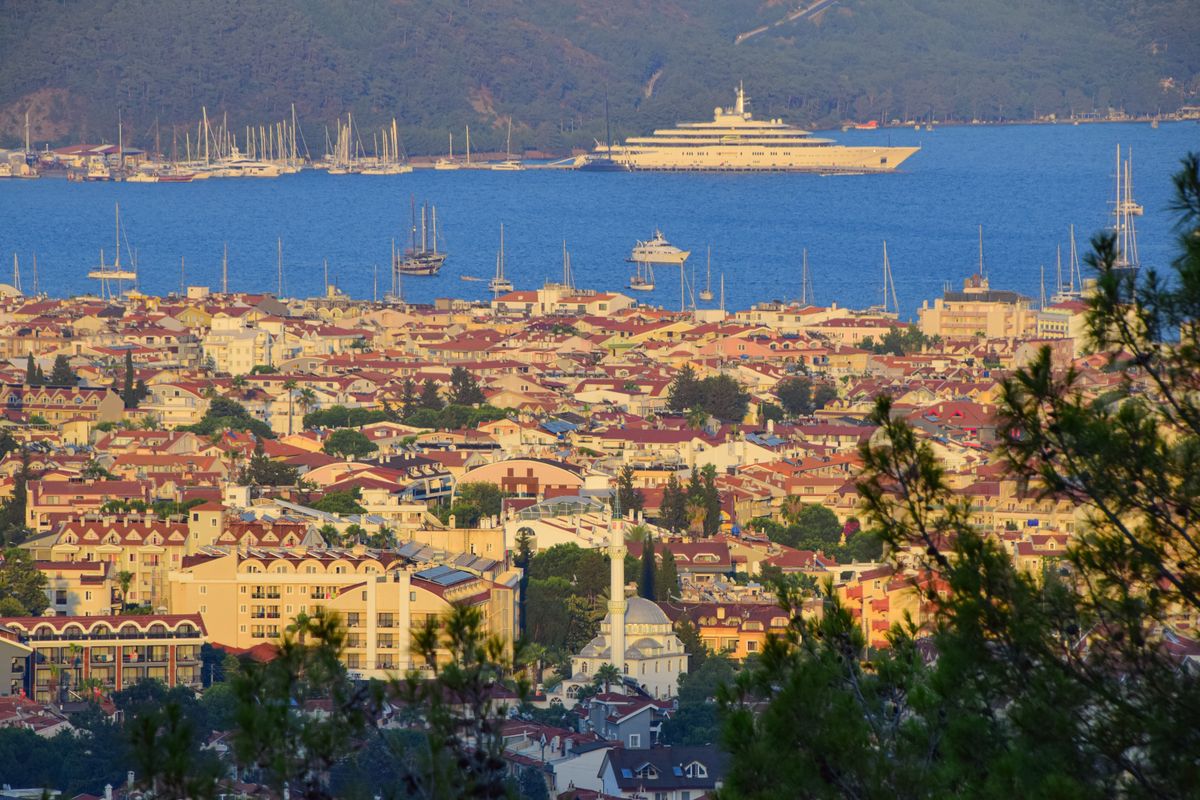
Netsel Marina occupies the eastern end of the seafront, tucked under the castle rock, and it is the reason this town has money: several hundred berths, motor yachts along the outer pontoons, a boardwalk of restaurants down the inner edge. A second and bigger basin at Adaköy takes much of the winter lay-up and refit trade for this end of the Mediterranean.
What most visitors come to look at are the gulets. A gulet is a broad-beamed wooden motor-sailer, heavily varnished, with a wide aft deck built for lying on rather than sailing hard; Marmaris and Bodrum are the two centres of the trade. A standard mavi yolculuk — blue cruise — runs east towards Göcek and Fethiye or north-west into the Gökova gulf across four to seven nights, and the boats leave in a noisy procession most mornings from May to October.
A castle Suleiman rebuilt in a hurry
Above the old town stands a small fortress with an outsized story attached. In 1522 Suleiman the Magnificent gathered his fleet in this bay before the siege of Rhodes and had the existing castle rebuilt to serve the campaign. By Ottoman standards it is modest — a courtyard, a curtain wall, a handful of chambers — thrown up for a specific war rather than for display.
French naval shelling damaged it during the First World War. Restoration through the 1980s put it back together, and it opened as the Marmaris Museum in 1991: amphorae raised from the seabed nearby, coins, costume and household material, arranged around the courtyard. Opening hours are published by the national museums directorate.
Forty-five minutes is enough. The collection is small and the English labelling patchy. Go for the walls and the view down over tiled roofs to the masts — that is what the ticket really buys — and go before eleven, while the terrace still has shade.
The lanes below the walls
Kaleiçi, the quarter wrapped round the base of the castle, is the one part of Marmaris that predates the resort. Whitewashed houses, bougainvillea, cobbles narrow enough that two people with shopping bags must negotiate. Restaurants hold most of the ground floors, and the bazaar spills up from the seafront in a tangle of carpet, leather, jewellery and counterfeit football shirts.
At nine in the morning it is genuinely pleasant. At half past ten at night, lamps on, better still. In between, through July and August, the selling is relentless: you will be addressed in four languages before reaching the end of a lane, and a polite refusal is not always taken as the end of it. Some visitors enjoy the theatre. Others are exhausted inside a day.
Is Bar Street as bad as they say?
Yes. Slightly worse, in fact, because the problem does not stay on the street.
Hacı Mustafa Sokağı — Bar Street to everyone who has ever set foot in it — runs a few hundred metres back from the old harbour, wall to wall with clubs, and works at full volume until four or five in the morning through the season. Inside it, that is entirely the point, and nobody who goes is being misled.
Carry is the difficulty. Sound travels across still water and up the slope behind the town, so hotels several streets back, and parts of the seafront itself, take a low thump until very late. Anyone with an early flight, small children or a low tolerance for bass should establish exactly where a hotel sits in relation to that street before paying, and treat "central" in a listing as a warning.
Marmaris in August is a crowded, loud, hard-selling place that rewards people who want exactly that and punishes everyone who does not. The town is not the problem. Mismatched expectations are.
İçmeler, and the case for staying eight kilometres away
Follow the shore road west and the hotels thin, the mountains close in, and after about eight kilometres you arrive at İçmeler. Steep pine-covered slopes rise almost straight up behind the seafront, giving the place a hemmed-in quality Marmaris itself lacks. Its name points at the springs that once supplied the settlement.
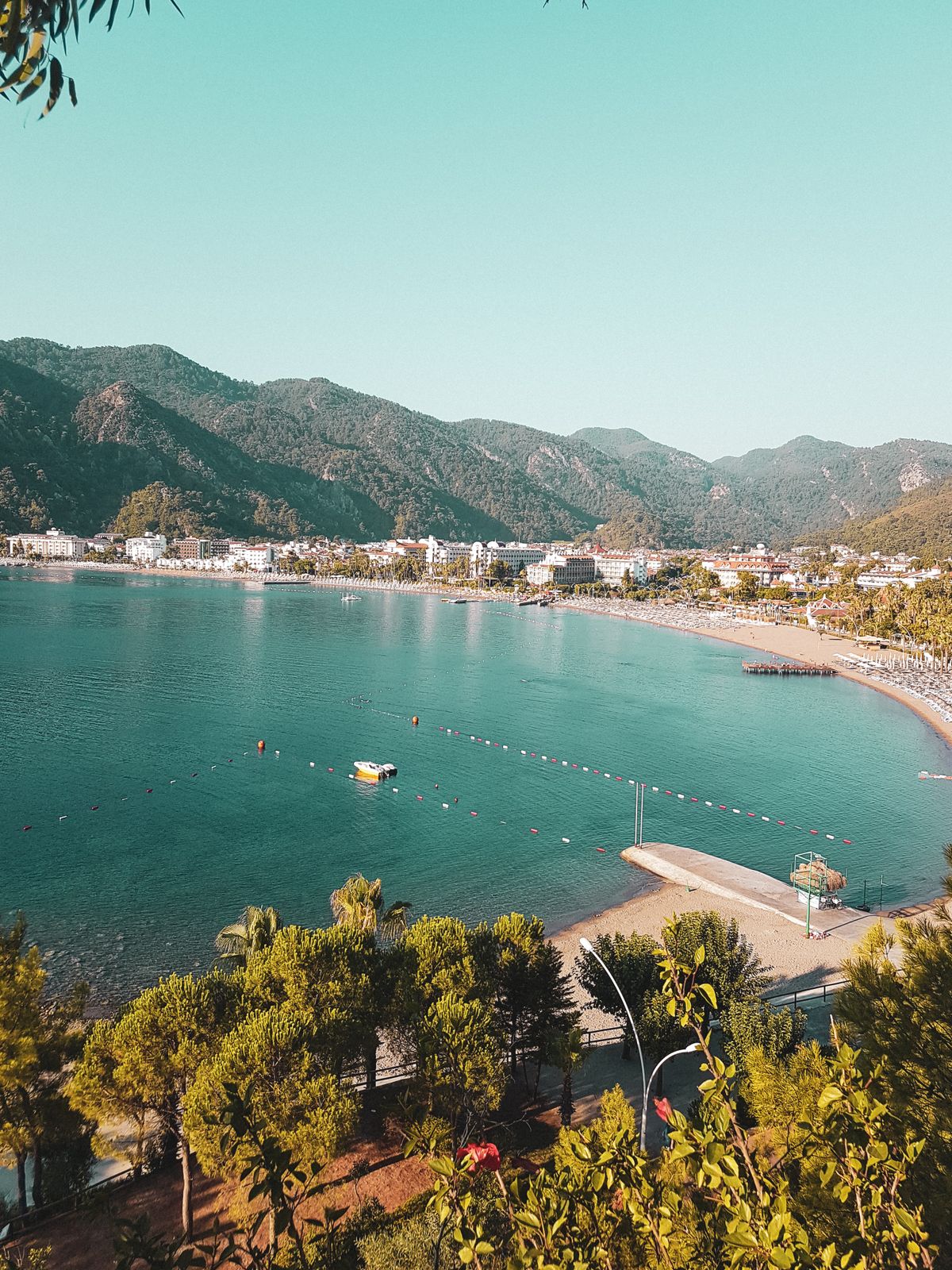
Calmer in every measurable respect, and better for swimming: coarse sand and shingle, clearer water, well away from harbour and ferry traffic. Marmaris town beach, the long strip along Uzunyalı, is honestly unremarkable — narrow, hard underfoot, busy with boats a short way offshore. Evenings finish earlier here, the crowd skews towards families, and the bar strip is a fraction of the size.
Choice is what you surrender. Restaurants number in the dozens rather than the hundreds, and anybody wanting a specific night out ends up on a dolmuş into town, then thinking about how to get back.
Round the headland beyond, roughly 20 km away by a tight mountain road, Turunç is smaller again — one bay, a short line of hotels, steep ground on every side. That road genuinely winds. Passengers prone to travel sickness should take the boat.
Wildfire burned much of the forest above this bay in the summer of 2021, and the scars behind İçmeler and Turunç remain visible. Regrowth is under way, but arrive expecting patchwork rather than unbroken pine.
The water dolmuş
Small passenger boats work the bay as a shuttle — the deniz dolmuşu, or sea dolmuş — running from the Marmaris seafront to İçmeler, Turunç and the smaller bays beyond. Roughly hourly in season, and not at all in winter.
Slower than the road, then, but far more pleasant, cheap, and free of the mountain bends. For İçmeler the sensible pattern is boat out, dolmuş back: the last sailing is early, often around six, while minibuses run late into the night. Check that departure at the quay first.
Wider notes on dolmuş, water taxis and the roads themselves sit in the transport entry.
Who this suits
Reduced to something usable:
- Nightlife, volume, the full resort machine — Marmaris centre, close to the old harbour.
- Families, swimming, early nights — İçmeler, without hesitation.
- Boats, charters, the start of a blue cruise — Marmaris, near Netsel.
- Quiet bordering on isolation — Turunç, if the road does not defeat you.
- Anyone tied to late July or August — book well away from Bar Street and swim before ten in the morning.
May, June and September make the strongest case. Water climbs into the mid-twenties by June, holds around 27–28°C through August and is near 24°C in early October, and the selling is less aggressive outside peak. Winter empties the town: half the seafront shutters and the boats stop.
Getting here from the airport is set out in the arrivals entry; the marinas at the opposite end of the province — quieter, dearer, rather more serious about boats — are covered in the Göcek entry. Local information comes from the municipality, a regional overview from GoTürkiye, and the longer history from Wikipedia.