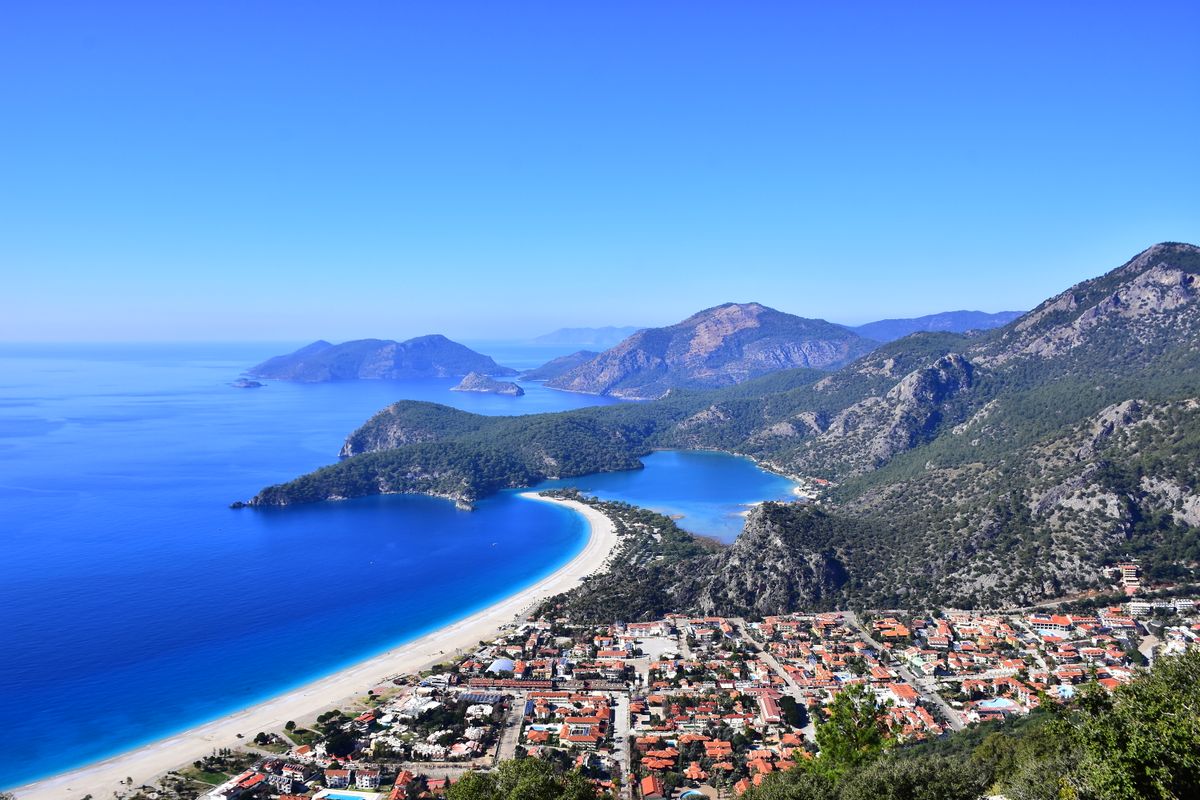
Ölüdeniz is the photograph. Anyone who has glanced at an advertisement for a Turkish holiday in the last thirty years has seen this lagoon — the hooked spit of pale shingle, water shifting from clear to jade to deep blue in three visible steps, a pine ridge over the whole arrangement. Some places shrink once they become famous. This one, mostly, does not.
What shrinks is the experience of standing in it during the second week of August.
Three separate places need pulling apart first, because hotel websites and dolmuş boards use the single word Ölüdeniz for all of them: the lagoon, the open beach beside it, and the resort strip on the plateau five kilometres above.
What the lagoon actually is
Ölüdeniz translates as "dead sea", and the name describes behaviour rather than biology. A curved shingle spit closes off a shallow bay from the open Mediterranean, so the water inside barely moves. When the coast outside is choppy, the lagoon sits flat as a filled bath. That stillness is the entire appeal. In high summer it is also the entire problem.
Access runs through a gate, because the lagoon lies inside Ölüdeniz Tabiat Parkı, a designated nature park. A modest per-person charge applies, seasonal, irritating mainly to people who assumed a beach this famous would be free. Sunbeds and umbrellas are rented separately. Motorised craft are banned inside the water, which is why nothing louder than a pedalo crosses it.
Depth builds gently. Wading a long way out and still standing at chest height is normal, which makes the lagoon good for small children and dull for anyone who wants to swim properly. Through July and August the water sits around 26–28°C — enclosed, shallow and unstirred, it heats faster than the open sea and then holds onto it. Late in a hot August that reads as pleasant for about four minutes, and as tepid bathwater thereafter.
Belcekız, where people actually swim
Walk back out through the park gate, turn along the front, and you are on Belcekız: the open public beach facing the sea directly, no fee and no barrier. Shingle again, coarser underfoot, with a shelf that drops away a few metres out.
Most of the swimming at Ölüdeniz happens here, and most visitors work that out inside a day. Belcekız has small waves, water two or three degrees cooler than the lagoon, depth enough to swim a proper length, and a line of restaurants and bars immediately behind it. Louder, busier, less photogenic — and where the afternoon reliably ends up.
Paragliders land at the eastern end, which turns that stretch into free entertainment for most of the day.
Kıdrak, and the argument for keeping going
Three kilometres further round the headland, on the narrow road that eventually climbs to Faralya and Kabak, sits Kıdrak. Another nature park, another small charge, and a wholly different atmosphere: pines running almost down to the shingle, real shade at the back of the beach, and a fraction of the people.
Dolmuşes run out from Ölüdeniz through the season. Facilities are thin — a snack bar, showers, little else — so bring water. For anyone who came to swim rather than to look, Kıdrak is the best of the three by a clear margin.
| Beach | Entry | Water | August crowds | Best for |
|---|---|---|---|---|
| Blue Lagoon | Nature park fee | Flat, shallow, warmest | Heavy from mid-morning | Photographs, young children |
| Belcekız | Free | Open sea, small waves | Heavy but spread out | Swimming, food and shade nearby |
| Kıdrak | Small park fee | Open sea, deeper | Moderate | Pines, quiet, a real swim |
Babadağ, the mountain that made the name
Behind the resort the ground goes almost straight up. Babadağ — "father mountain" — reaches 1,969 metres barely six kilometres inland from the shore, and that combination of height, sea breeze and dependable thermals has made it one of the best-known tandem paragliding sites anywhere.
Ramps are cut at several levels along the ridge, the highest close to 1,900 metres. A flight runs roughly 25 to 40 minutes depending on the launch point and the air, spirals down past the ridge line, crosses over the lagoon and lands on Belcekız. Hundreds of tandem flights leave on a busy summer day. Register that before booking: this is an industrial-scale operation rather than a private adventure, and the gap between careful operators and careless ones is real.
Since 2021 a cable car has run up the same mountain, climbing from the edge of the resort to stations at roughly 1,700 and 1,800 metres in under twenty minutes. Restaurants and viewing platforms sit at the top, and the effect has been to change who goes up — plenty of people with no intention of jumping off anything now ride it purely for the view over the lagoon and along the coast towards Fethiye. Late afternoon, when the light comes across the water, is the better call.
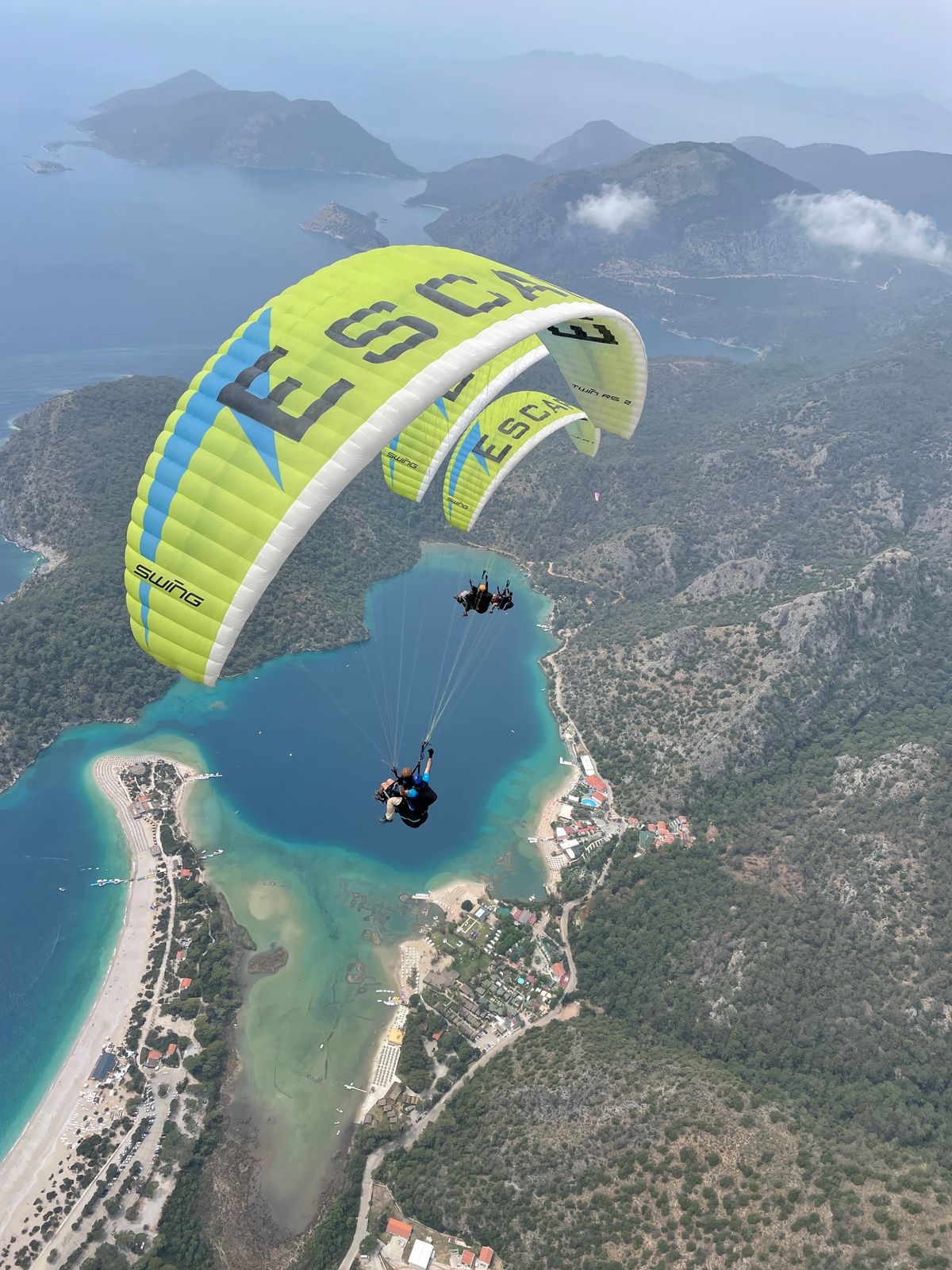
Flights are cancelled for wind, and cancellations are not rare. Booking on your last full day leaves nowhere to reschedule to. Mornings usually offer smoother air; midday thermals make for a bumpier ride. Anyone prone to motion sickness should say so on the ground — the spins near the end of the descent are optional, and a competent pilot will leave them out.
Is it worth it in August?
Honestly, only partly.
Through July and August, Ölüdeniz is overrun in a way that no photograph of it has ever shown. Lagoon sunbeds go early. Cars back up on the single road down from Ovacık, the car parks fill by mid-morning, and the shingle becomes a continuous mat of towels and bodies. Water that felt like a luxury in June feels like something already sat in.
None of that makes the place a fraud. It makes it a place with a season, and most people book the wrong one. Late May and June deliver the same colour with a fraction of the crowd, at around 22–24°C. September is better still — the sea holds its heat into October, the flying air is good, and the resort thins week by week. The question of timing matters more here than anywhere else on this coast.
The lagoon is what you came to see. Belcekız is where the afternoon will actually be spent. Anyone claiming otherwise has not tried to find a free metre of lagoon shingle at midday in the second week of August.
The strip on the hill: Hisarönü and Ovacık
Ölüdeniz has almost no room to build, hemmed in by protected land on one side and the mountain on the other, so most of the bed stock sits four to five kilometres uphill in Ovacık and, beyond it, Hisarönü.
Be clear about what that strip is. Hisarönü is a dense run of bars with British names, karaoke rooms, tribute acts, all-day breakfasts, football on screens and tailors calling from doorways. Ovacık, lower down and greener, is a quieter version of the same idea. Plenty of visitors book there deliberately and get precisely the holiday they wanted. Others arrive expecting a Turkish coastal village and spend a fortnight quietly appalled.
Neither reaction is wrong. Not knowing which one you have booked is the mistake. If that strip holds no appeal, stay down in Ölüdeniz proper, or base yourself in Fethiye and come across for the day.
Dolmuşes shuttle between Hisarönü, Ovacık and Ölüdeniz constantly through the season and run late into the night, so staying uphill costs convenience rather than access. Walking down is a different matter — steep, unlit in stretches, no pavement for much of it.
Getting there, and what to take
From Fethiye, dolmuşes leave for Ölüdeniz all day and take roughly half an hour, climbing over the ridge on hairpins the drivers handle with more confidence than passengers tend to enjoy. Dalaman Airport is about 65 km away, an hour or so by road, with no direct coach — arrivals change at Fethiye or arrange a car, a decision set out in the arrivals entry.
A short list of things worth having:
- Water shoes. All three beaches are shingle, and the stones at Belcekız are big enough to hurt.
- Cash for the park gates at the lagoon and at Kıdrak.
- Your own shade if you arrive at the lagoon early, before the umbrella rental gets moving.
- A day of slack in the itinerary if paragliding matters to you.
One walk deserves mention. An old footpath climbs over the hill from Ölüdeniz to Kayaköy, the abandoned Greek village on the far side. Two to three hours up through the pines, steep in places, and not something to start in the middle of a July afternoon. Done early, with water, nothing else within walking distance comes close.
Outside the season, the place closes. Between November and March most hotels and restaurants shut, the flying stops, and Ölüdeniz reverts to a quiet bay with a locked park gate and almost nobody in it. Regional practicalities are published by Fethiye municipality and the national tourist board at GoTürkiye; the nature parks and their entry charges fall under the Ministry of Agriculture and Forestry.