Saklıkent translates as "hidden city", which sounds like a tour operator's invention and turns out to be roughly honest. From the road you cannot see it at all. Approaching across the Eşen plain you get flat farmland, greenhouses, a few tractors, ordinary-looking mountains behind — then the lane ends at a car park and there is a slot in the rock with cold air pouring out of it in the middle of a thirty-eight degree afternoon.
What happens after that divides arrivals fairly cleanly.
Some walk the boardwalk, look at the water, decide it is far too cold, and go and have lunch. Others take their shoes off, get a third of the way across, put them back on and go and have lunch. A minority continue up the riverbed. Knowing in advance which of those you are matters, because the drive is long.
Eighteen kilometres, of which you see about one
Length is the figure printed on every board at the entrance: roughly eighteen kilometres, among the longest gorges in the country. Discount it straight away. Walking distance for anyone without ropes, a guide and an obliging river is nearer four kilometres, and most visitors cover a fraction of that before turning back.
Depth is the more useful measurement. Walls rise steeply from the riverbed on both sides — repeated figures run to two or three hundred metres, and while the exact number depends on where you stand, the effect at the narrow sections is not in dispute. Daylight arrives as a strip. In places the gap between the faces is tight enough that a reasonable arm could throw a stone across.
Water on limestone did all of it. The river drains the Akdağ massif at the western end of the Taurus range, cutting downward through soft rock over a very long time. Gorge and slopes together became a national park in 1996 — hence the gate, the modest fee and the posted rules — administered by the Directorate of Nature Conservation and National Parks rather than the municipality.
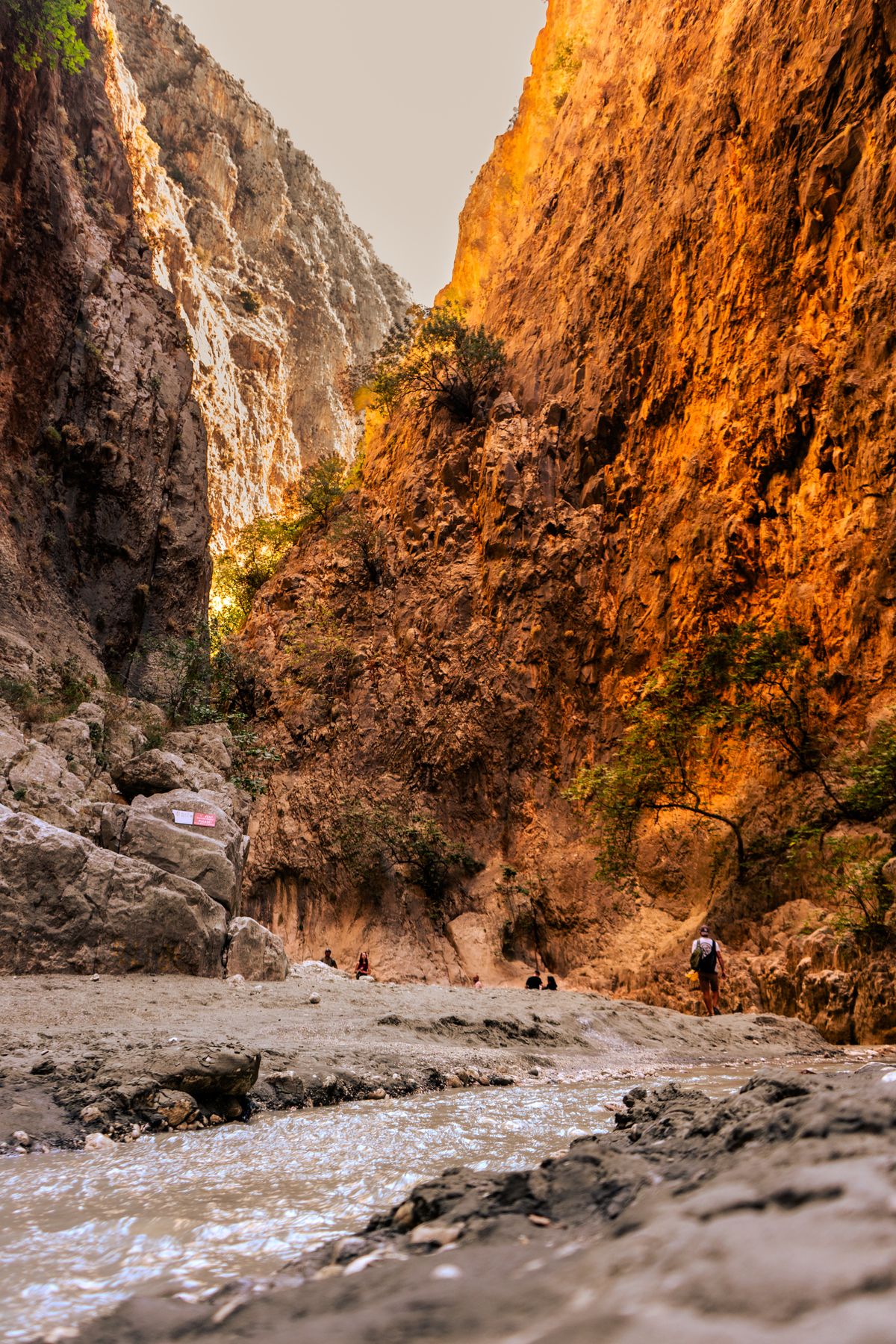
The walkway bolted to the rock
A footbridge crosses the river below the ticket gate, and a raised wooden walkway begins on the far side — clamped into the cliff face a few metres above the water, following every bend, handrail on the open side, timber underfoot, river loud below. Good engineering, doing the one job that matters: carrying you through the tightest, most vertical stretch without anybody getting wet.
A couple of hundred metres in, it stops.
Where it stops is the most interesting spot in the place. A tributary comes straight out of the rock wall under pressure — the Ulupınar spring, arriving from inside the mountain — and hits the main stream at close to a right angle. Noise is considerable. So is the volume, which turns the next twenty seconds into a decision rather than a formality.
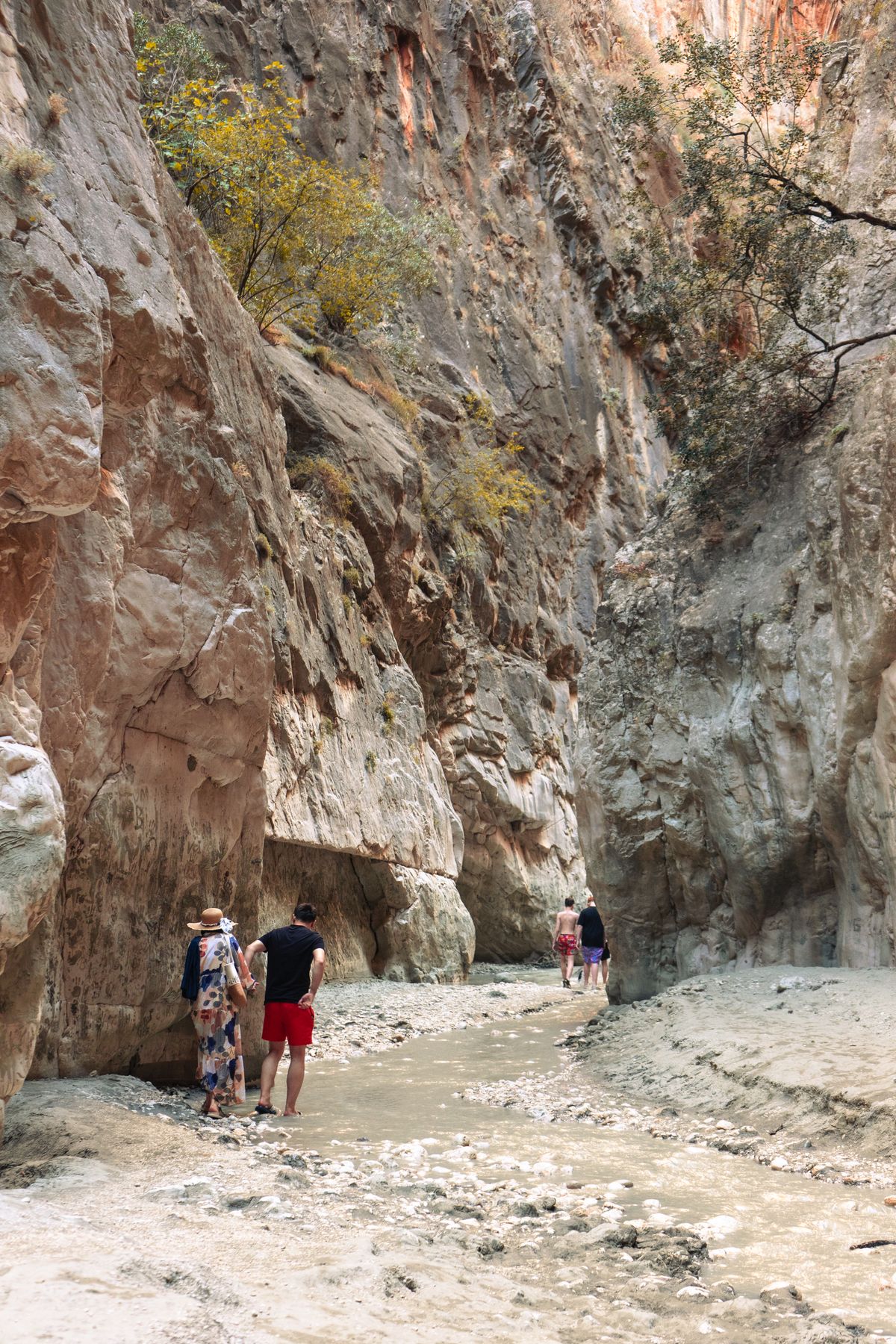
How cold is the water? Cold enough to be the point
To go further you wade. No bridge, no stepping stones, no dry alternative — beyond the walkway the gorge floor is the river, and going upstream means crossing the confluence and then walking in and out of the water for as long as you keep going.
A rope is usually strung across for people to hold. Depth shifts season to season, generally between shin and thigh, and the current moves fast enough to unsettle your footing on the loose bed. That part is manageable.
Cold is the part nobody warns you about properly. This was snow days ago, it has been underground since, and it does not warm up in August because direct sun barely reaches the gorge floor. Feet ache after about ten seconds and go numb soon after. Adults shriek. Whole coach parties reverse at this exact line, which is why the far bank is emptier than the boardwalk behind it.
Bare feet and flip-flops are the wrong answer, and the reason is the rock rather than the cold — polished limestone and rounded boulders under moving water, genuinely slippery. Rubber grip shoes are sold at the entrance for very little. Buy a pair, or bring old trainers you do not mind soaking.
Past the crossing the walls step back and the gorge widens into a gravel bed, where progress means picking a line between boulders and shallow pools. Grey sulphurous mud collects in a side pool and visitors plaster themselves in it, bake dry and rinse off in the river. Three or four kilometres up, a waterfall and a rock blockage turn the walk into canyoning with equipment. Almost nobody gets that far.
The months it works, and the months it does not
Seasonality here is not about comfort. It decides whether the gorge is physically passable at all, and through spring it frequently is not.
Snowmelt off the Akdağlar pushes the river up hard in April and May. At high water the crossing is out of the question, the riverbed section closed, and after mountain rain the site can shut with little notice — a gorge is a funnel, and water that fell two hours upstream arrives without asking. Late June through September is the working season; September into early October the pick of it, with the river lowest, air still warm and coach schedules thinning.
| Period | River | What you can do |
|---|---|---|
| November–March | High, cold, unpredictable | Largely closed; not worth planning around |
| April–May | Snowmelt peak | Walkway only at best; crossing impassable |
| June | Dropping | Crossing usually opens mid-month onward |
| July–August | Low, still freezing | Full access, heaviest crowds, hottest car park |
| September–early October | Lowest | Best walking, thinning coach traffic |
Nothing about opening hours or river level is worth assuming from a distance. One night of rain on the Akdağ changes conditions, and access is sometimes cut back to the walkway without any announcement reaching the resorts. Driving ninety kilometres for this? Ask at the hotel desk that morning, not the week before.
Lunch on a platform over the river
Built out over the water at the entrance, on stilts and scaffolding, is a run of trout restaurants that are half the reason coaches come at all. Low tables, kilim cushions, no chairs, the river a hand's width beneath the boards. On a day in the high thirties, the temperature gap between platform and car park is worth the meal on its own.
Order the alabalık — trout, farmed in the cold water upstream, grilled whole with lemon and raw onion. Gözleme comes off a convex saç griddle at the front, folded around cheese, spinach or potato. Ayran, salted and cold, is the correct drink and the one thing every platform gets right.
This is a captive market and it prices accordingly. Food sits at the expensive end for what is fundamentally a village lunch, and standards vary noticeably between platforms. Go early, before the cushions nearest the water fill and the kitchens are cooking for four coaches at once.
Getting there from the coast
Saklıkent sits in the Seydikemer district of Muğla province, at the village of Kayadibi, roughly forty-four kilometres from Fethiye. Allow fifty minutes: east on the D400, then inland across the Eşen plain, the last stretch climbing toward the mountain wall. From Dalaman Airport it is about ninety-five kilometres and an hour and a half.
Public transport exists but is tight. A dolmuş runs from Fethiye otogar in season, roughly hourly at the busiest times, and the constraint is the journey back rather than out — the last return tends to leave mid-afternoon, forcing the visit into a narrow window. How the minibus network behaves generally is covered in the register's transport entry.
With a car, pair the gorge with Tlos, fifteen kilometres up the same valley, where Lycian rock tombs are cut into the cliff below an Ottoman fortress. Ruins first, gorge after lunch — the other order puts you at the tombs in full heat.
Worth the drive?
Conditionally, and the conditions matter:
- Yes, in September — low water, warm air, a fraction of the August crowd.
- Yes, before ten or after four — midday belongs to the coaches, and the entrance area is small.
- No, if you want a long hike — the accessible walking is short and much of it is standing in a river.
- No, in April or May — you will pay to look at a walkway and go home.
- Careful with small children — the crossing is fast, cold and slippery, and a child who refuses it ends the day for everyone.
Judged honestly, Saklıkent is a thirty-minute experience wrapped in a three-hour trip — still one of the few places in this province where the landscape does something unexpected, and the drive up the Eşen valley is worth having done. For the seasonal picture across the coast, see when to visit. Regional background is published by GoTürkiye; the culture ministry lists the province's natural and archaeological sites at Kültür Portalı.